

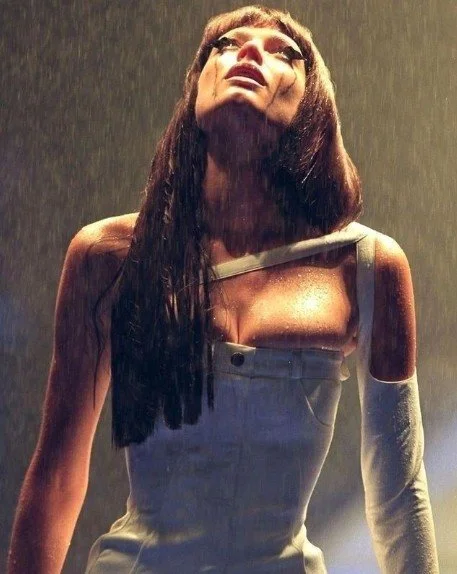
Alexander McQueen 1998 Spring Ready to Wear Fashion Show, ‘Untitled’
I am fascinated by the visceral effect that heartbreak has on the human psyche: the way an optimist loses balance and falls from cloud nine into the depths of misanthropy, or the way a free spirit becomes obsessed with pathologizing the sequence of events that led to the breakdown of a relationship. I am, of course, drawing on my own experiences as of late as I write this. What’s more, I find myself at present navigating a new world entirely. My storm has subsided. The ribbons of smoke released from the cord-cutting ritual have long been swept away into the stratosphere. But the earth beneath my feet is scattered with the tangled remnants of my love affair, my waking hours haunted by recollections of that indefinable blip in time.
I am torn. When I am alone, I can’t stop myself from reconstructing the echo of his name in my mouth. But to dream of him is to dissent from the crescendoing voices of my beloved women swirling around me: Don’t let him back in!
I trace the events that unfolded that night in January. I see him drunkenly collapsing into bed next to me, recall the sound of his voice, like raw honey dripping down tree bark, and his green eyes half closed as he whispered, over and over, kiss me. And the way my heart fluttered in my ribs as I held back. One moment, I was his best friend, his lover and his saviour. The next time I saw him, something had shifted. We were just friends. Nine moons later, I still cannot decode that moment in time.
But here is the silver lining: I am not alone. I am not the first, nor the last, to lose myself momentarily to the claws of heart ache. This is well documented;a mere glance down the corridor stacks of a library or a waltz through an art exhibition will reveal to the trained eye that fragments of all human emotion have been preserved in time, be it in leather-bound novels or sewn into the seams of an evening gown worn by a faceless model. So, while I toss and turn over the memories of him like contradictory pieces of evidence in a criminal case, I take some small relief in the knowing that this path has been walked before.
In typical Scorpio Moon fashion, I find a seductive sense of refuge in the act of submerging myself into worlds that exist on the periphery of reality; of Gothic literature and Baroque theatre, a headspace where fictions and histories collide. For instance, I find some strange comfort in picturing myself as a heroine from a play penned by the likes of Aphra Behn or William Shakespeare, my real-life tribulations removed from reality and reimagined in the context of the grandiose and the macabre.
It would seem that I am not alone in this fantasy. A keyword search on Instagram or Pinterest will show you a carousel of popular “aesthetics” – dark academia, whimsy-goth, and most recently, ‘bard-core’– are surging in popularity. The appeal of darker subcultures is prevalent in the sustained popularity of landmark literary works including Frankenstein and Wuthering Heights, while modern-day musical artists too are being rewarded for their honest and ambitious portrayals of worlds tainted by the complex nature of human relationships – look at rising artists Ethel Cain, Sofia Isella or Erin Le Count, or to established stars such as Halsey, Taylor Swift or Florence Welch.
Indeed, there is something powerful about the creation of a visual identity that prioritises expressions of female pain and power. It is not simply that Baroque and Gothic imagery has become fashionable once more; it is that the accumulation of ornate detailing, rich artistry and thoughtful storytelling serves the purpose of creating a space in which women can find catharsis and alchemy. In these digital spaces where Dionysian and Occult aesthetics form the foundations, I identify two key mechanisms: on one hand, women’s voices are spotlighted. In these spaces, the patriarchal tradition of concealing female rage and grief is subverted by offering a place where discussions of the feminine experience are made public and henceforth made undeniable. On the other hand, there is something delicious about rejecting the conservative ‘clean girl’ aesthetic and instead choosing to shroud oneself in cloaks of velvet and to adorn oneself in misshapen pearls and gems. In summation, the resurgence of the likes of ‘vamp-core’ and ‘witch-core’ speaks to more than a short-lived microtrend. To me, at least, my heart swells with the knowledge that my emotional toil has a home; one where devastation becomes poignant and spectacular, and desire is welcomed, not rejected, for all its imperfectly indulgent glory. Ultimately, to adopt fragments of the Gothic or the Baroque is to relish in the inherent beauty and chaos of the female condition… and find lightness once more.
words by Sophie Marchbank
