

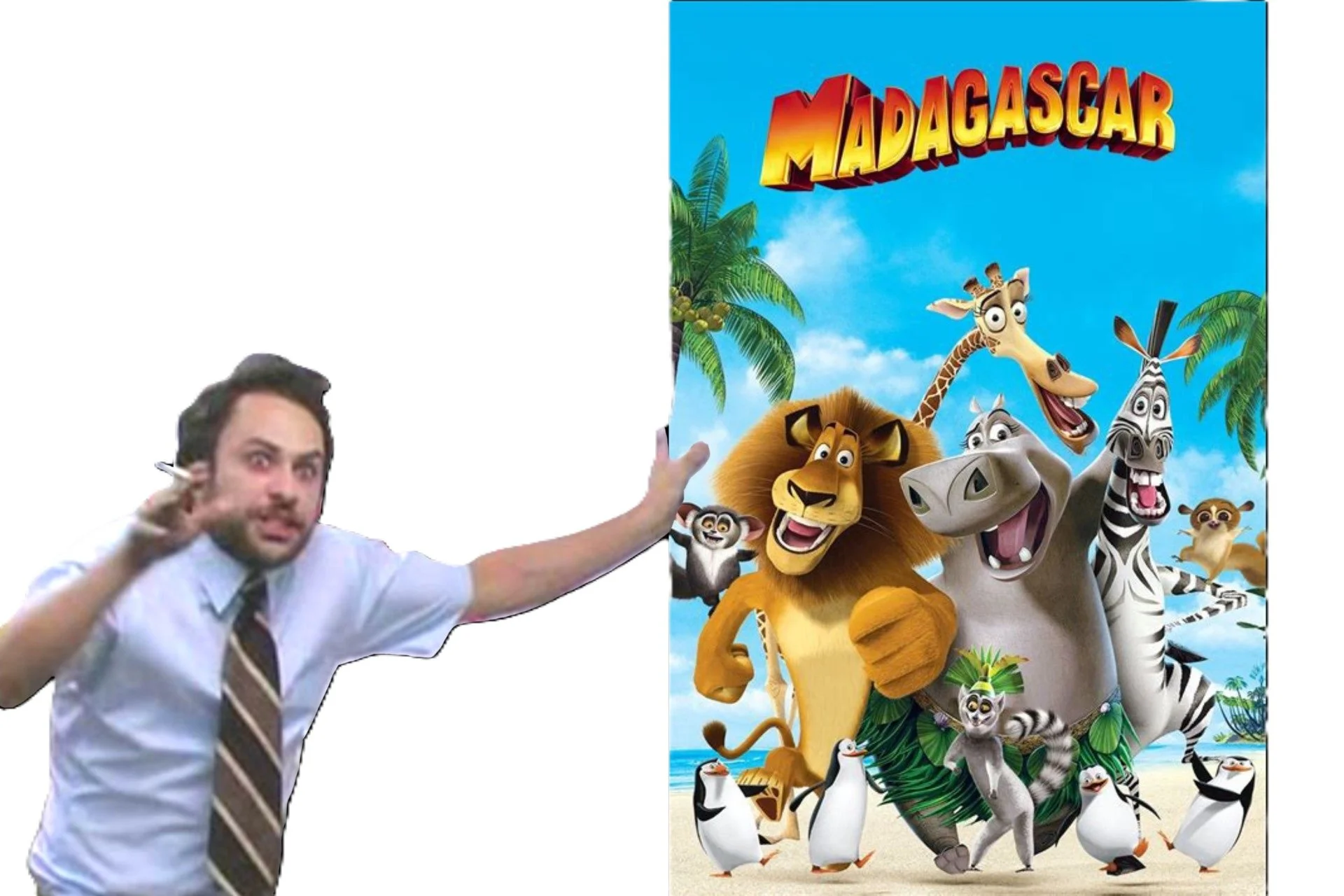
I watch the Madagascar film series regularly. How regularly, I’m not telling you. But I’ve seen it enough times that I’ve started to seriously think about the wider implications of the films. Obviously, there’s the delightfully on-the-nose coming-out allegory in Madagascar Two: Escape to Africa (2008) that we all know and love. But today I want to focus on the first film, and a power structure that is so implicit you’ll barely notice it on the first eighty-or-so watches. But once you see it, it’s everywhere.
To explain it, I’m going to take you to meet an enemy of mine: Victorian anthropologist Edward Burnett Tylor, writer of Primitive Culture (1871). Eddy BT thinks that all groups of people and cultures slot into a nice evolutionary line with ‘primitive’ on one end and ‘civilised’ on the other, and technologies such as written language marking transitions towards ‘civilisation’.
“But Eve,” I hear you cry, “That would imply that cultures without certain technologies are somehow less evolved than others. Isn’t that super racist?”
Well, yes! But don’t worry, the Victorian era was a long time ago. I’m sure nobody thinks that way today.
Except, well… Except maybe the makers of Madagascar (2005).
You see, there is an immediately present yet unquestioned power dynamic that we are introduced to in the first ten minutes of the film. Humans are in power, and zoo animals are subservient. There is an emphasis on medicine (Melman is treated to MRIs and pills on the reg), bodily maintenance (the treadmill in Marty’s pen), and most importantly, submittance. The animals must work to the zoo’s timetable and please guests for the implicit contract between themselves and the zoo to be fulfilled. Every minute of their day is directed by human beings: the zoo opens, they perform for visitors within the zoo hours, they are fed, they sleep. This is a great example of biopower, a power system theorised by a close personal friend of mine, Michel Foucault. The animals are indirectly managed through the reinforcement of beneficial behaviours and instillation of ideology that pushes them to self-enforce their own subjugation.
To adapt to their zoo environment, the animals adopt and coopt human traits. Mimicry within colonialist structures is explored by writer Homi Bhaba, who notes that it is used as an oppressive tool to enforce othering, or as a tool within oppressed groups which can help them regain power when used to their advantage. Here, we will focus on just one aspect of this mimicry: language. Stick that in your back pocket for a moment while we return to the plot.
Marty is the only one of the four protagonists to ever question the system they live within. When he voices these doubts aloud, he is met with swift social rebuke. As the film progresses, Marty’s commitment to his own free will ends up landing (apparently the entire zoo?) on a ship to Kenya. The troubling ecological implications of this aside, this represents an ultimate rejection for the animals who are still operating within the human — zoo animal power dynamic. Alex is the most affected, shouting at Marty that he ‘bit the hand’. More plot, some chaos, and some penguins later, and the gang ends up washing ashore on the island of Madagascar.
It is in Madagascar that we are introduced to an extension of the human-zoo animal power hierarchy. Our human-aligned, American-accented and fluently speaking protagonists immediately seek the comforting bars of their old cages in the arms of a new human overlord (anyone will do!). What they find instead is a wild lemur party.
Remember that language mimicry thing in your back pocket? Take it out, we’re going to look at it now. Language is at play instantly as we, the audience, are introduced to the lemurs. Their leader, King Julian, has a strong but easily understood accent, and seems to lead more with personality than brains. His right-hand-man Maurice is American-accented, and obviously more sensible and intelligent than his boss. Their creepy little sidekick, Mort, has a loose grasp of the English language and is immediately dismissed by his lemur peers every time he speaks. Note: it is possible to accurately guess each lemur’s intelligence purely from their use of English.
Enter stage right: the foosa. They say, “Foosa hungry, Foosa eat.” a clear (and, dare I say, highly logical) communication of intent and reasoning. They also demonstrate impressive culinary abilities by making Mort into a tossed salad, and react with neutral friendliness and curiosity to Alex until he roars and scares them away by accident. Looking at this evidence, we may conclude that this group of foosas are capable of coordinating as a team and food preparation. They are not initially violent to outsiders — so perhaps the lemurs are wrong about their apparent ‘savagery’? Ah, but they can’t speak English, so they must be the villains of the plot.
There is clear linear developmental theory at play in Madagascar: a line drawn from savagery to civilization, which correlates directly with use of language. The Foosa represent the most ‘savage’ end of this line, and later in the film when Alex descends into wildness, he will gain physical and linguistic traits that mimic those of the foosa (saying, for example, “Alex hungry, Alex eat.”) The most civilised end of this line is, naturally, humans. Then the animals structure themselves in order of most human-like, with the most clearly spoken animals being granted the most power. The zoo animals, who can most clearly replicate the culture and language of humans, are treated as the most rational and powerful characters in the film. This is not a point that the film is making; it is an assumption that the filmmakers have made: that this implicitly colonial logic will feel so natural and digestible to the families watching that we won’t even notice, and will in fact be able to use it as shorthand in our assumptions about each character’s intelligence. Edward Burnett Tyler would be proud.
words by Eve Woehrling
